

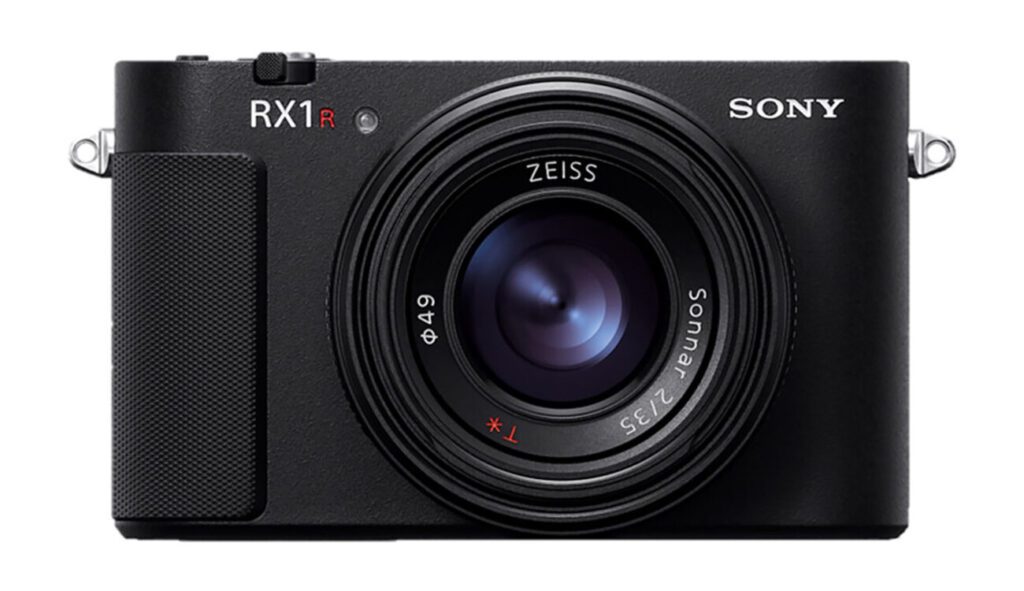
Ten years later, SONY revamps this camera.
Sony has unveiled a third generation of its high-end compact camera, the RX1R III, ten years after its predecessor, the RX1R II, was released in 2015. At first glance, this update maintains the same compact structure and continues to feature a stylish fixed lens, but now incorporates a 61-megapixel sensor, improved image processing, and enhanced focusing.

The sensor is still a back-illuminated Exmor R full-frame type, without a low-pass filter and with anti-reflective coating, mimicking the configuration of the A7R V. This decision translates into very high image quality and a dynamic range of up to 15 stops (according to Sony), a notable feature for those seeking sharpness and detail without compromise.
The brain that processes this data is the BIONZ XR, crowned with an artificial intelligence chip that facilitates a hybrid autofocus system with 693 PDAF points and advanced recognition of eyes, bodies, and even vehicles. It is a clear heir to what the A7R V offers, but in a smaller body.
The lens chosen is still the classic 35mm f/2 Zeiss Sonnar T*, a choice that has become iconic thanks to its resolution and character. This version adds the ability to shoot in minimum macro mode at 20 centimeters (0.26×) and an electronic cropping function—called “step crop”—that allows you to simulate focal lengths of 50 mm (29 MP) and 70 mm (15 MP). All this, of course, without changing lenses, maintaining the operational simplicity that defines the model. This is a trend we have also seen in Fujifilm’s latest compact cameras.
In terms of handling, the camera retains its small dimensions—113 × 68 × 75 mm and weighing about 498 g—with a magnesium alloy body, controls aligned with Sony’s modern aesthetic, and a more consistent grip. However, the OLED viewfinder has 2.36 million dots and the screen also has the same resolution as its predecessor, and it is also a fixed screen, a decision that saves space but limits ergonomics at low angles and is sure to put off many photographers and content creators who will not be able to take advantage of a reversible screen, or even a tilting screen to shoot comfortably at high or low angles. Simplicity comes at a price.
For hybrid photography, the RX1R III offers 4K recording at 30 fps with 10-bit color depth, and Full HD at 120 fps. It also includes 12 “Creative Looks” profiles and the popular S-Cinetone, sought after by those who appreciate a cinematic aesthetic without post-processing.
The price will exceed $5,000, a significant figure that places it in the range of high-end compacts such as the Leica Q3 and medium-format cameras such as the Fujifilm GFX100RF. This means that, although it offers top-notch performance for its category, it also competes directly with more versatile systems and interchangeable lenses.
Among its great virtues are outstanding image quality with extreme resolution in a portable body, immaculate focus with intelligent tracking, focal crop versatility, and advanced video profile. But there are some sticking points: the absence of IBIS stabilization, a modest battery life of around 300 shots, a fixed viewfinder and screen, and a price tag that makes you wonder if an A7C R with interchangeable lenses might not be a better option. Many users are wondering whether the flexibility of a zoom lens is worth more than accepting the limitations of a fixed lens in favor of a compact system.
Compared to the Leica Q3, for example, the Sony is smaller and lighter, but the German camera has an advantage in terms of features: an articulated screen, optical stabilization, a higher-resolution viewfinder, 8K video, and IP53 sealing. Therefore, despite its compact pocket size and superb performance, the new Sony RX1R III has some serious weaknesses, such as its viewfinder, lack of stabilization, and fixed screen, which detract from its practicality, especially considering its price tag.
It is clear that the Sony RX1R III does not seek to please everyone, but rather a very specific buyer profile: demanding travelers, street photographers, documentary filmmakers, and hybrid professionals who want the best of Sony in a compact camera. The absence of IBIS, the fixed screen, and the high cost limit its versatility, but for those who value the brand’s maximum quality, this camera will continue to be an option to consider.
For those who prefer the flexibility of interchangeable lenses, there is the Sony A7C R or the A7C II; for those who opt for an iconic camera and a complete compact system, the Leica Q3 or the Fujifilm GFX100RF are very serious rivals.